
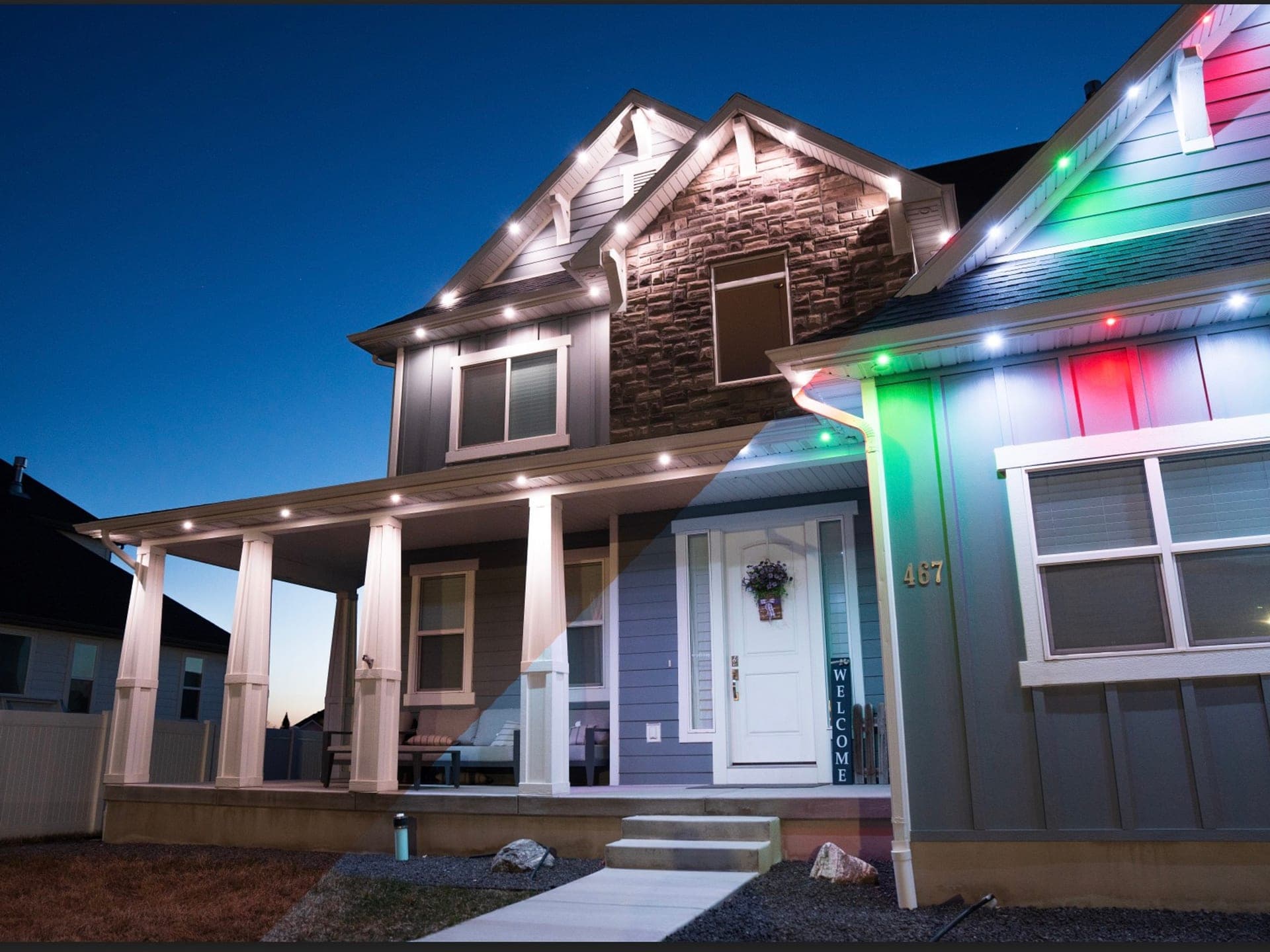
Key takeaways
- The aluminum track is painted to match your soffit or fascia and clips into the soffit or fascia channel with no roof penetration.
- Each RGBW LED is individually addressable, so every point of light can be a different colour or brightness.
- A low-voltage power supply and controller usually plug into an exterior GFCI outlet and send data along the LED run.
- The app stores scenes, schedules, timers and zones, so the lights run automatically once set up.
- Components are IP67 sealed, cold-rated to minus 40 degrees Celsius and rated for 50,000 plus hours of LED life.
The Four Parts of a Permanent Lighting System
Every permanent roofline system has four main components working together. The track is the visible housing along your roofline. The LEDs sit inside the track and produce the light. The power supply converts household power into the low voltage the LEDs need. The controller is the brain, translating what you choose in the app into data that tells each LED what to do.
Understanding these parts helps you compare quotes. Two systems can look identical from the street on installation day but differ in track quality, LED density, weather sealing and how capable the app is. Those differences show up years later in how well the lights hold colour, how they look in daylight and how easy they are to use. A good installer will explain each part plainly.
- Track: aluminum channel, colour-matched to soffit or fascia
- LEDs: individually addressable RGBW nodes, IP67 sealed
- Power supply: converts 120V household power to safe low voltage
- Controller and app: stores scenes, schedules, zones and timers
The Aluminum Track and Colour-Matching
The track is a slim aluminum profile that runs along the underside of the soffit or the face of the fascia, following the roofline around corners and up peaks. It protects the LEDs from snow, ice and sun, and it gives the installation a straight, finished line. Because it is aluminum rather than plastic, it will not sag or become brittle after years of Ontario temperature swings.
We colour-match the track to your existing soffit or fascia, whether that is white, black, brown, grey or a less common shade. When the lights are off, the track blends into the trim and is hard to notice from the street. Installation uses the soffit or fascia channel itself, so nothing goes through the shingles or roof deck. That protects your roofing warranty.
Individually Addressable RGBW LEDs Explained
RGBW stands for red, green, blue and white. Mixing red, green and blue produces more than 16 million colours, while the dedicated white channel gives a clean, natural white instead of the slightly bluish white you get by mixing RGB alone. That white channel is what makes everyday accent lighting and warm white Christmas scenes look right. It is the W in RGBW that earns its keep daily.
Individually addressable means each LED node has its own tiny chip and can be told to show a different colour and brightness from its neighbours. That is what allows chases, twinkles, gradients, alternating holiday patterns and precise spotlighting of doors or peaks. Non-addressable strips can only show one colour along the whole run, which limits what you can do. Rated LED life is 50,000 plus hours.
Power Supply, Controller and Wiring
Household current runs at 120 volts, but LEDs operate on low voltage. A weatherproof power supply handles that conversion, usually mounted in a protected location near an exterior outlet, in the garage or in the attic space. For longer rooflines, power may be injected at more than one point so colours stay consistent from one end to the other. This is planned during the quote.
The controller connects to your home Wi-Fi and sends data down the LED run. Most installations simply plug into an existing exterior GFCI outlet. If an outlet needs to be added or a dedicated circuit is preferred, that work should be done by a licensed electrical contractor under the Ontario Electrical Safety Code, with an Electrical Safety Authority (ESA) notification of work. Cabling between sections is UV-rated and routed tidily along the trim.
How the App Controls Your Lights
Once the system is online, the app becomes your control panel. You can choose a solid colour, pick from saved holiday scenes, build your own patterns, adjust brightness and speed, and turn zones on or off independently. Changes happen within a second or two, so you can try ideas from the driveway and see the result immediately. Brightness can be fine-tuned the same way.
Schedules are where the system really saves effort. You can set warm white to come on at sunset every day, switch to a Halloween scene for the last week of October and run a Christmas pattern from December 1 to January 6. After that, the lights largely run themselves. During our install, we set up starter scenes and schedules and walk you through the app before we leave.
What Happens on Installation Day
Most residential installs take one to two days. The crew confirms the layout and zones with you, mounts the colour-matched track along the planned runs, seats the LEDs, routes power and data cable, and installs the power supply and controller. Each run is tested section by section so any issue is caught before the crew packs up. The work area is tidied before the crew leaves.
Before booking, we offer a free on-site demo where we colour-match your soffit, mount a live sample section and light it at night. That lets you see the brightness, the LED spacing and how the track looks against your trim, so there are no surprises when the full system goes up. It is free, and there is no obligation to buy if the look is not right for your home.
Frequently asked questions
Do permanent lights need a separate electrical circuit?
What happens if the Wi-Fi goes down?
Can one LED be replaced if it fails?
Do I need to drill into my roof?
See the system working on your own roofline
Our free on-site demo mounts a live, colour-matched sample section on your house and lights it at night so you can judge it in person.